.jpg "Savills")
The Polish Purpose-Built Student Accommodation (PBSA) market is undergoing a remarkable transformation. It has been over a decade since the first investments were made in the sector. As Poland has cemented its position as a leading academic hub in Central and Eastern Europe, the demand for high-quality, well-located student housing continues to rise.
Students in Europe
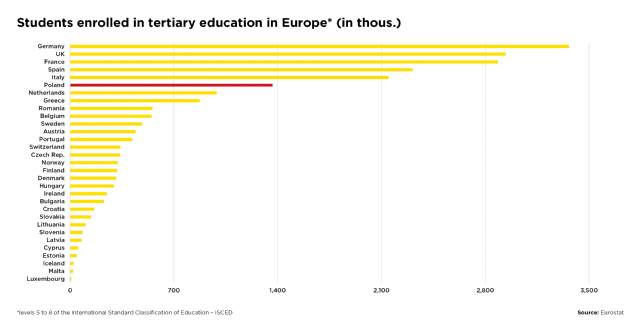
In 2022, there were 17.8 million students enrolled in tertiary education across the European Union. Germany, which is the EU’s most populous country, also led in terms of students population with 3.4 million people enrolled, accounting for 18.9% of the total EU student population. Following Germany were France with 16.2%, Spain with 13%, Italy with 12.1% and Poland with 7.7% share of the total number of students in the EU. Poland is therefore the fifth largest country in terms of student numbers in the European Union. However, if to include the UK, where the number of students is close to 3 million, Poland drops to sixth place.
Studying aborad is gaining on populairty as it empowers students to acquire valuable skills and broaden their perspectives. A survey funded and supported by the European Commission among young Europeans between 15 and 30 years old (Eurodesk Youth Info Survey 2022) shows that over 90% of respondents are open to the idea of going aborad for a mobility experience. Going aborad for studying and/or training is considered to be beneficial not only to their personal life, social and intercultural skills but also their education and professional career.
As OECD data shows, despite disruptions caused by the COVID-19 pandemic, across the majority of countries, the share of international students has increased between 2013 and 2022. In many countires, international students has increased between 2013 and 2022. In many countries, international students make up more than 10% of the student population. In Luxemburg even more than half of all stundents are citizens of other countries, while in the United Kingdom every fifth student is an international one. When European countries are analysed the three countires with the highest growth between 2013 and 2022 where Croatia (from 0.5% to 3.6% share of international students), Poland (from 1.5% to 6.5%) and Estonia (from 2.9% to 11.9%).
.jpg "Image treatment")
Bed provision in Europe
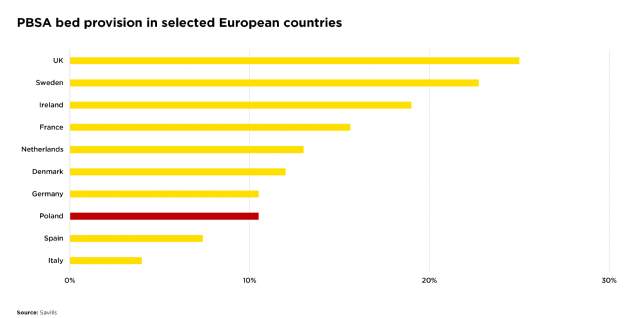
The average bed provision rate, calculated as total number of beds divided by total number of students across European countries differs significantly reaching from as low as 4% in Italy to ca. 25% in United Kingdom. In Poland, only 1 in 10 students can find a place in a dormitory, which indicates an undersupplied market compared to most Western European countries. The rate, both in Polish and European cities, also spreads between as low as 3% in Rome to 30% in Prague.
Students in Poland
Student population in Poland
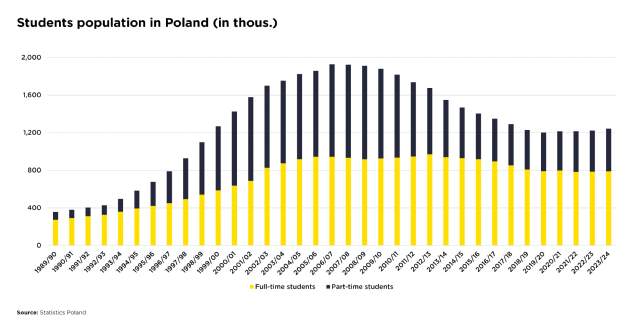
Total number of students in Poland in the academic year 2023/24 was 1,242,921 (as of 31 December 2023), of which close to 64% decided to study full-time. A total of 358,329 students enrolled in the first year, with almost 56% of them being women. Domestic students represent nearly 64% of the population of young people aged 20-24 and about 3.0% of the country’s total population.
.jpg "Image treatment")
Since 1990, the number of students in Poland has grown steadily, with the largest increase in the second half of the 1990s – an average of 16.8% year-on-year. This growth continued until 2006 when it peaked at 1.93 million students. Since 2007, the number of students has been declining annually, but this has been in line with general demographic changes and a decrease in the youth population in the country. Furthermore, in the 1990s nad early 2000s, young people were taught that a university degree was key to a career, often ignoring education quality. Over time, pursuing a degree solely for its own sake declined, reducing student numbers.
However, over the past four years, there has been a slight reversal of this trend, with student numbers starting to increase again, although the growth is very subtle.
Major academic cities
In Poland there are eight major academic hubs, each with more than 50,000 students: Warsaw, Kraków, Wrocław, Poznań, Tricity, Lublin, and Katowice, along with Gliwice (which together have a total of 66,358 students). The first four, being main cities, are the largest academic centres. Each of them is home to prestigious universities and research institutions, attracting many students both national and international. The presence of good universities in these cities is a valuable resource, as it translates into population growth, the development of public infrastructure, increased living standards and improved labour market conditions.
Warsaw is the country’s leading academic hub, with over 60 universities and many other science institutions such as the Polish Academy of Sciences and the University of Warsaw’s Centre for New Technologies. The second largest academic centre is Kraków, with Poland’s largest technical university – AGH, which also has the biggest university campus in the country, where most of the teaching facilities, the main faculties, student organisations and University Student Campus with 20 student houses are all located. A wide range of academic programs, rich cultural and entertainment life, relatively low cost of living and friendly environment make both Wrocław and Poznań another popular choice for students, right after Warsaw and Kraków.
International students in Poland
With a wide range of English-taught programes, relatively low tuition fees and cost of living, and different scholarship opportunities Poland is a great choice for students from all over the world. The internationalisation ratio at Polish universities has increased over the past 15 years from as little as 0.9% in 2009/2010 to 8.6% in 2023/2024 academic year. A total of 107,130 foreign students studied in Poland in the academic year 2023/24, of which 36,257 were first-year students (as of 31 December 2023). This is almost five times more than it was in 2010 and over 16 times more than in the year 2000.
One of the reasons for this growth could be the launch of programmes such as “Study in Poland” created by the Conference of Rectors of Academic Schools in Poland (KRASP) and the Perspektywy Education Foundation. The programme promotes Polish universities abroad, encourages young people to study in the country and provides all the necessary information on the study process, as well as on moving and various aspects of life in Poland.
Another initiative impacting the number of international students is the Erasmus programme (known as Erasmus+ since 2014), which Poland has been a part of since 1998. The programme supports the exchange of academic communities between universities, promoting the sharing of knowledge and experiences. According to Rad-on, the average number of Erasmus students coming to Poland in the past seven years has been around 3,500 per year – with the exception of 2020 due to pandemic restrictions. In the 2023/24 academic year, the highest number of Erasmus+ student was documented in the following voivodeships: Mazowieckie (588), Dolnośląskie (413), Pomorskie (412) and Małopolskie (389). Almost 53% of the programme students were from Spain, followed by Turkey (9.9%), Italy (7.1%) and France (5.3%).
.jpg "Image treatment")
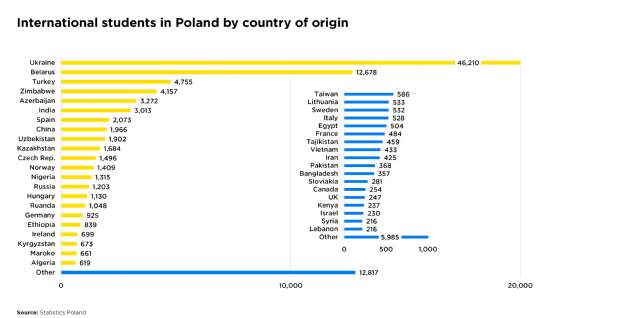
For several years, Polish universities have been dominated by students from Ukraine and Belarus, who in the academic year 2023/24 accounted for more than half of all foreign students (55%). The next largest groups were Turkish (4.4%), followed by students from Zimbabwe (3.9%) and Azerbaijan (3.1%).
The dominant nationalities differ across the major cities, although Ukrainians definitely rank first. For instance, in Lublin, students from Zimbabwe are second in terms of numbers. In Szczecin, aside from Poland's eastern neighbours, Germans and Norwegians make up a significant proportion. Similarly, in Kraków, Norwegians rank high, in third place.
The 2022 war led to a significant influx of the Ukrainian population into Poland, which was also reflected in the increase in the number of students of Ukrainian origin. However, the large presence of Ukrainians at Polish universities in not only the result of the outbreak of a full-scale conflict. Ukrainians have been the largest group of international students since the 2013/14 academic year. Furthermore, Ukraine has been a key focus for promotional and marketing efforts within the “Study in Poland” program since 2005. In 2019/20 academic year, 39,017 Ukrainians studied in Poland (47.5% of total number of international students), while in the 2022/23 academic year there were 48,056 (45.6%).
Over the last 15 years, the percentage of students of Polish origin has dropped significantly from 21.5% in the academic year 2008/09 to just 5.9% according to the latest data. The overall increase in the number of international students indicates that every year studying in Poland is becoming a more attractive option for young people despite having no connections to Poland.
Student housing in Poland
In Poland, the majority of student accommodation is owned by public higher education institutions. In the 2023/24 academic year, there were 418 student houses offering 112,414 beds, while private HEIs provided 2,775 beds across 25 dormitories. Private investors add another 15,690 beds to the overall supply, of which 13,195 beds are distributed across 33 modern PBSA projects, which offer higher standard and more available beds – approximately 400 on average per project. The remaining 43 student residences offer only 2,495 beds (58 beds on average each) and are of lower standard.
A large number of dorms owned by public institutions are old and poorly maintained. Most rooms are shared by two or three students, with bathrooms and kitchens typically located in corridors and shared with other residents. Amenities in these student houses, which include gym, game and focus rooms, and shared spaces designed for socializing are also of lower standard.
However, the issue of outdated public dormitories is becoming more widely acknowledged, and universities are taking steps to improve the accommodation available.
More student houses are undergoing renovations, such as the Eskulap dorm at the Poznań University of Medical Sciences and one of the Lublin University of Technology dormitories. Several universities, such as the University of Warsaw and the Naval Academy of the Heroes of Westerplatte, have built new dormitories for their students.
Modern private PBSA projects offer significantly higher quality compared to public facilities. These accommodations usually consist of single and double rooms, each with a private bathroom and kitchenette. The average room size is approximately 16 sq m for singles and 20-25 sq m for doubles. The rooms are fully furnished, and the entire facility is designed with modern, user-friendly layout.
Most PBSA projects have an on-site team focused on supporting students, offering repair assistance and o 24/7 security system. To attract students, private investors ensure a wide range of amenities, including study rooms, chill-out areas, laundry, gyms, game rooms, cinema rooms and shared kitchens. Many operators also organize various cultural events that help residents socialise.
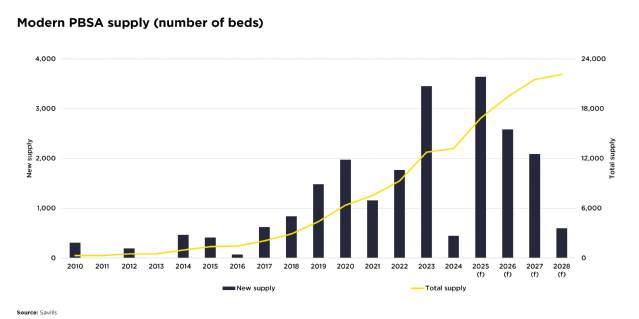
The pipeline for the PBSA market over the next few years appears to be quite promising. Assuming all planned projects are developed, the supply of beds in Poland will grow by nearly 9,000 by 2028. Approximately 4,100 beds are currently under construction across 10 projects, which accounts for more than half of the total pipeline. Four of them are located in Warsaw, three in Kraków, and one each in Gdańsk, Poznań and Olsztyn. 88% of the projects under construction are planned to open in late Q3 2025.
Bed provision rate
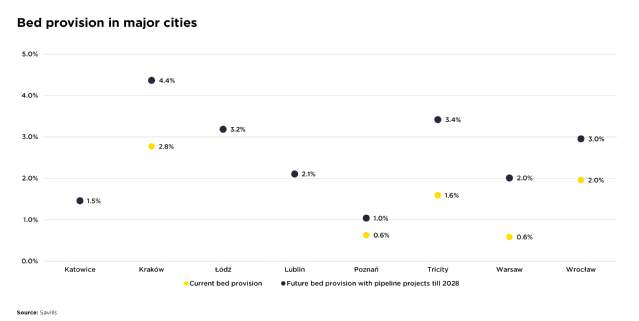
In Poland, only 1 in 10 students can find a place in a dormitory, which indicates an undersupplied market compared to most Western European countries. The availability of beds varies between cities: Łódź has the highest provision at 16.9%, followed by Lublin - 15.6%, Kraków - 15.2% and Wrocław at 10.2%, while Warsaw and Katowice are at 7.4% and 7.1% respectively. However, as mentioned before, most of the available places are in low-standard public dormitories. If we consider only modern private dormitories, just 1% of students can expect to find a place in such a facility. This ratio also changes depending on the location. Students in Łódź have the highest chances of finding accommodation (bed provision of 3.2%), followed by Kraków (2.8%), while those in Warsaw and Poznań face the lowest availability of beds in modern projects (0.6% each).
If all projects scheduled for completion by 2028, based on investors plans, are built, bed provision is expected to increase from 1.1% to 1.8% in private modern dormitories. The largest growth will occur in Tricity, Kraków and Warsaw – 1.8 percentage points, 1.6 percentage points and 1.4 percentage points respectively. In contrast, Katowice, Łódź and Lublin will see no change in bed provision, as there are currently no projects in the pipeline for these cities through 2028.
Rents
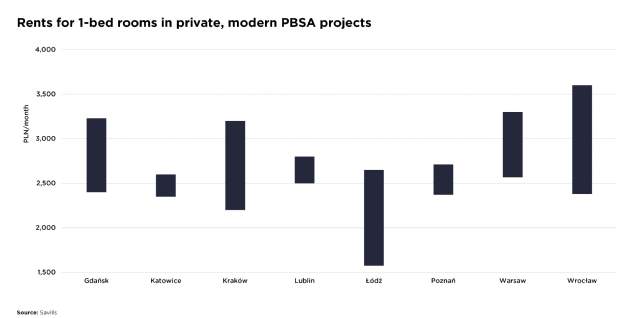
Rents for student housing in Poland vary based on factors such as location, standard, rooms size and available amenities. For a 1-bed room unit ranging from 14 to 20 sq m, monthly rent can range from PLN 1,575 to PLN 3,300. Larger single units, measuring between 20 and 27 sq m, cost between PLN 2,050 and PLN 3,600 per month. The highest rents are found in Warsaw, Kraków and Wrocław, while the lowest are typically seen in Łódź
The size of 2-bed rooms available on the PBSA market can vary significantly, which affects their price. For instance, options start at PLN 725 per person for a 10 sq m room, and can go as as high as PLN 2,600 per person for a 35 sq m apartment. For 2-person units with an area of 10 to 20 sq m, the monthly rent ranges between PLN 725 and PLN 2,150 per person. For 2-bed rooms measuring between 20 and 30 sq m, monthly rents can range from PLN 1,230 to PLN 2,460 per resident. The largest available options, with sizes ranging from 30 to 40 sq m, cost between PLN 1,470 and PLN 2,600 per person per month.
Investment market
Over the last couple of quarters investors who are already active in the so-called living sector in Poland or in the broader CEE region, as well as new investors focused on “beds” have shown considerable interest in the student housing market in Poland. Some investment managers have even switched their focus from the popular PRS to the PBSA sector, starting to underwrite their first projects and even signing preliminary purchase agreements. The interest in the sector has grown on the back of a perception of strong market fundamentals, including significant supply shortages of modern student beds, solid rental growth over the previous years and generally good performance of operating assets.
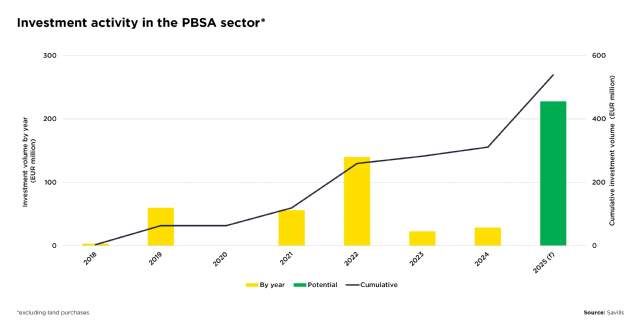
But since it is a niche market where the target tenant group consists of people from a certain age cohort, investment volumes are low compared to other asset classes. In 2024 the investment volume in the PBSA market did not exceed EUR 30m with only one transaction closed involving a standing asset in Kraków and no forward deals. Historically the strongest year in this respect was 2022, when the volume reached EUR 140 million.
So far, investors have invested ca. EUR 310 m in operating assets and in forward deals. 2025 may become a record year in this respect as we see potential for investments exceeding EUR 200 million. At the same time, our estimation of the total value of all existing and operational PBSA assets in Poland would be ca. EUR 800 million. For perspective, this is equivalent of the value of two large shopping centres traded in 2024. Although the volumes remain relatively tiny compared to traditional commercial real estate, the momentum is clearly growing in the PBSA sector.
The first signs that investment activity in the PBSA market is gaining pace are now visible. In January 2025 Kajima / Student Depot acquired a prime development site in the Wola district and Xior Student Housing announced its plans to acquire two standing assets, one in Warsaw and one in Wroclaw.
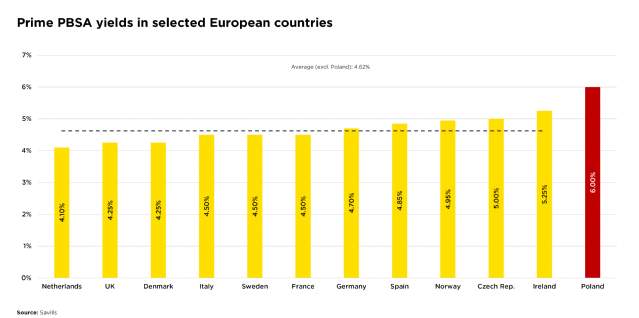
Yields in the PBSA market in Poland remain attractive for investors. Compared to Western European markets prime assets in Poland offer a yield of ca. 6% (in Warsaw, potentially slightly below that figure), while prime yields in the UK, for instance, are at 4.25%. The average prime yield for the selected peer group of countries is 4.62%. There is also room for yield arbitrage for investors willing to take on development risk, as yield on cost in Poland can exceed 8%.
We do not expect any considerable yield compression in the coming months.